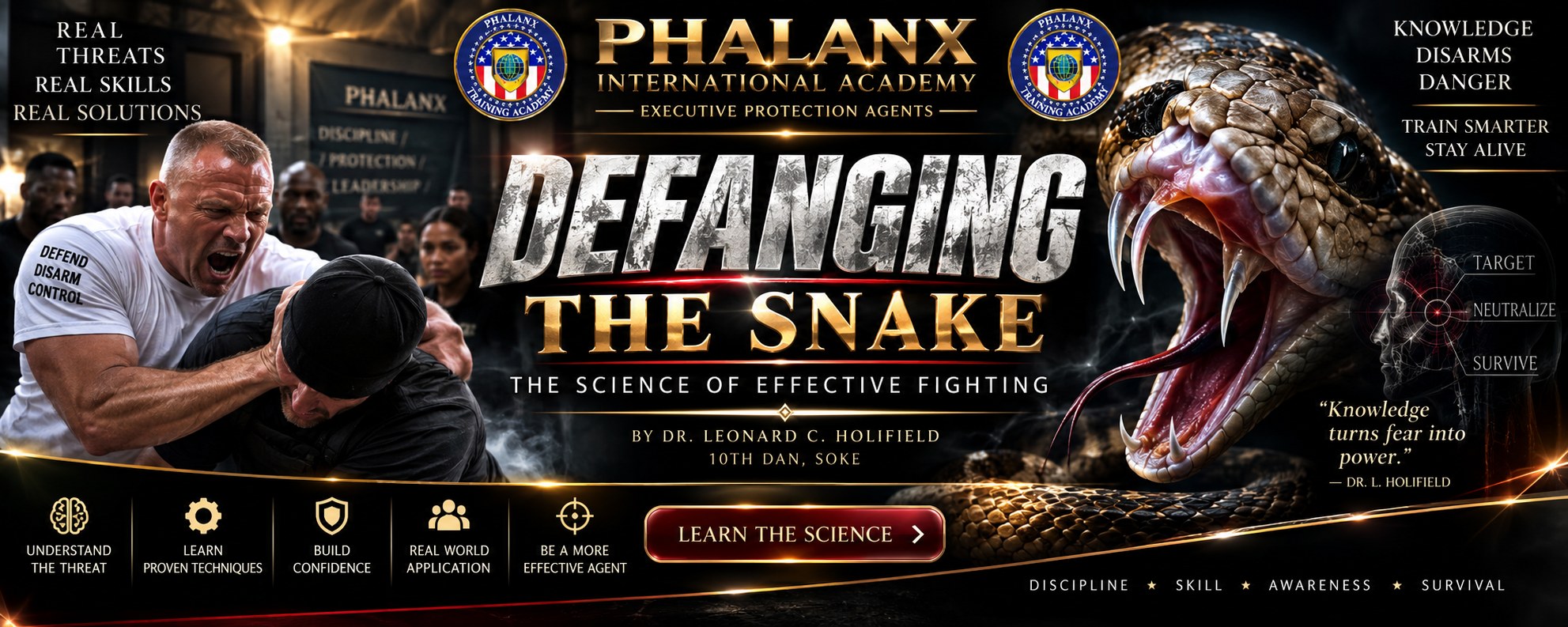
In the field of executive protection, unarmed self-defense tactics are a must. During your entire career as an EP agent you may never have to fire a single shot from your firearm — however, it is almost certain that you will at some point have to get up close and personal with someone who decides he doesn't like your client very much.
In cases like this, you should be prepared to meet the attack not only with effective self-defense counter-measures, but with a sound understanding of the human body and the knowledge to end the attack quickly and effectively.
The Snake
What would you do if someone suddenly threw a poisonous snake at you? Most sane people would jump back in fear of being bitten. Now take that same snake and break off his fangs. Would you flinch at a fangless snake thrown your way? Most likely not — because the snake's bite is now useless.
We know a snake's bite can be lethal, and the fear of dying from it automatically puts us on the defensive: it raises blood pressure and adrenaline. But a poisonous snake that cannot deliver his venom is, in fact, useless. His primary weapon is his fangs.
The Five Fangs
Man's five weapons are his two arms, two legs, and his head. Each arm can strike, grab, and choke. The legs deliver powerful kicks, stomps, and sweeps. The head can deliver incapacitating headbutts and bites. As with the snake, man can be defanged.
Man's primary weapons are his arms and hands — so the focus is on destroying these and rendering them useless. We accomplish this by breaking the wrist and/or fingers, breaking the arm at the elbow, or dislocating the shoulder. With a broken wrist or fingers, your opponent simply cannot make a fist — and he certainly can't strike you, for the pain would be too great and any strike ineffective.
The legs can be neutralized by dislocating the patella, breaking the leg at the knee, or hyper-extending the knee to cause extensive ligament and tendon damage — breaking the ankle or small bones of the foot, or cutting the Achilles tendon. The head houses the control center of the body. The target is not the skull itself, but the temple — the weakest point — or the jaw, which operates on a hinge and can be broken to prevent a bite and cause a knockout.
Defanging — or limb destruction — is an art in and of itself. It is quick and effective no matter the size or skill level of your opponent. Once the limbs are destroyed through bone fracture, torn ligaments, or nerve damage, they become ineffective. How many pro football players have you seen go down from a knee injury? How many professional boxers get knocked out from a well-placed strike to the jaw? These are conditioned athletes used to punishment — and they still go down.
Three Ways to Stop an Attacker
The goal of attacking the limbs or vital points is to make your opponent stop what he is doing. There are three ways to accomplish this:
Make the attacker lose his focus. If he stops thinking about striking you, he stops trying to strike you.
Disrupt neuro-muscular control. A bruised nerve or muscle in the forearm means he cannot make a fist — so he cannot strike you.
Break the arm, wrist, fingers, or clavicle. The extreme pain alone means he won't try to hit you — whether he can form a fist or not.
The clavicle is a devastating target. Break one collarbone and both arms cease to function properly — the pain of using the other arm is virtually impossible to bear. I know this personally, having broken my right clavicle playing football in high school. A well-placed hammer strike can fracture it and destroy the integrity of your opponent's body.
The body is only as strong as its weakest link, and joints are generally weak — held together by muscle, tendon, and ligament. The knee is one of the strongest joints in the body, yet one of the weakest: it bears most of the body's weight, but strike it from the inside, outside, or front, and it breaks or dislocates, causing immediate incapacitation.
The Proper Mindset
To be an effective fighter you must possess a mindset that breaks through intimidation, fear of injury, fear of defeat, and the psychological weight of actually breaking a bone. You must first rid yourself of deep-seated sympathy or pity — no longer looking at your opponent as human, but as a Target. A target that must be destroyed.
Mike Tyson displayed this same mindset. Approaching the ring, fear flooded his mind — fear of his opponent, of losing, of disappointing his fans. But as he got closer, his confidence surged. Entering the ring, he saw his opponent as a Target invading his space, his world. He never lost eye contact. The result: knockout. Most of Tyson's fights were won before he ever stepped into the ring — his opponents were beaten psychologically before the first bell.
Assessing Your Target
You should have your opponent sized up before the first strike is thrown — his stance, his arm and leg position, his size, build, confidence, and focus, all assessed in seconds. Once the attack starts, you are already one to two steps ahead. Multiple follow-up strikes ensure quick incapacitation while keeping him off balance, mentally and physically, and on the defense.
Never focus on any single part of his body — not even his eyes. When you focus on one point, you miss all others; while you watch his eyes, he kicks your shin. Look at your opponent, and see everything. See the whole forest, not just the tree. See every weapon from head to toe, and be ready to answer each one.
Dr. Holifield has over 50 years of martial arts experience. He is the President and Founder of the International Academy of Executive Protection Agents and the Sikaron Karate Federation. He holds black belts in Judo (3rd Dan), Hapkido (6th Dan), and the Grandmaster rank of Judan (10th Dan) in Sikaron Karate. He is the former Chief Combatives Instructor to the United States Army and is featured in "Combative Masters of the 21st Century" (Lulu Press).